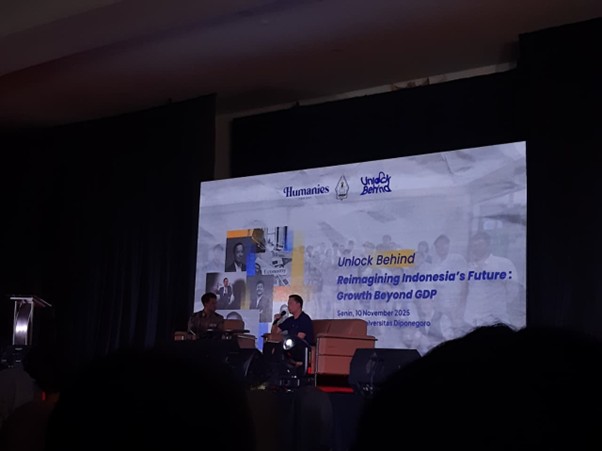
Humanies Project collaborated with the Student Executive Board (BEM) of the Faculty of Cultural Sciences (FIB) at Diponegoro University (Undip) to hold a public discussion titled Unlock Behind with the theme “Reimagining Indonesia’s Future: Growth Beyond GDP” on Monday (10/11/2025) at the FIB Multipurpose Building (GSG). This collaboration featured former Minister of Trade Thomas Trikasih Lembong as a speaker.
Quoted from LPM Hayamwuruk, Usamah Abdul Aziz, representative of the Humanies Project, said that the theme aimed to examine the correlation and validity between statistical figures and reality in society.
“Why did we choose this theme? Because nowadays there are many claims or figures circulating in the public regarding progress and the ability to increase Gross Domestic Product (GDP). We want to prove whether this is true, because what the community feels today is the opposite,” he said.
The chair of BEM FIB 2025, Nur Maajid Taufiqurrahman, explained that the main purpose of this event was to open a space for discussion on the relationship between the economy, the younger generation, and sustainability issues.
“Sustainability here refers to the sustainability of natural resources, the sustainability of young people’s lives, and so on. Although we are not focusing on the economy, the economy also considers humanitarian and sustainability aspects,” said Maajid.
Economic discussions cannot stop at numbers and statistical data. He said that the economy must be viewed from the perspective of human conditions and social realities, he added.
“Talking about economics is talking about the direct reality of society. Is society today truly prosperous? Of course not,” he said.
Enthusiasm and positive responses came from the audience, as this activity opened up new insights and perspectives for them. As stated by Sania Intan, a 2024 Library Science student, she felt she gained a new perspective through this discussion.
“As someone who is unfamiliar with the country’s economic statistics, the material presented provided an overview of the economic conditions and offered a different perspective,” she said.
“Economic issues and other similar issues really need a humanities approach to understand or find other perspectives that are sometimes overlooked,” she added.
Dr. Sukarjo Waluyo, S.S., M.Hum., Head of the Indonesian Literature Study Program at FIB Undip, appreciated and fully supported this public discussion. He hoped that this would inspire other students to be more active and aware of life issues, as well as to actively participate in various activities in other Indonesian Literature Study Programs.
Reporter: Titin
Author: Titin
Documentation: Titin