Students from the Indonesian Literature Program (Sastra Indonesia/Sasindo), Faculty of Humanities, Diponegoro University (UNDIP), who are part of KKN Team 1 Sub-Team 94, carried out a comprehensive population data update and village potential mapping in Kragilan Village, Gantiwarno District, Klaten Regency. The program was implemented from January 6 to February 10, 2026, as part of UNDIP’s Community Service Program (Kuliah Kerja Nyata/KKN).
This initiative aimed to provide accurate, up-to-date data to support village development planning and policy formulation. By conducting direct field observations and verifying family registration cards (Kartu Keluarga), the team ensured that the collected data reflects the actual conditions of the village community.
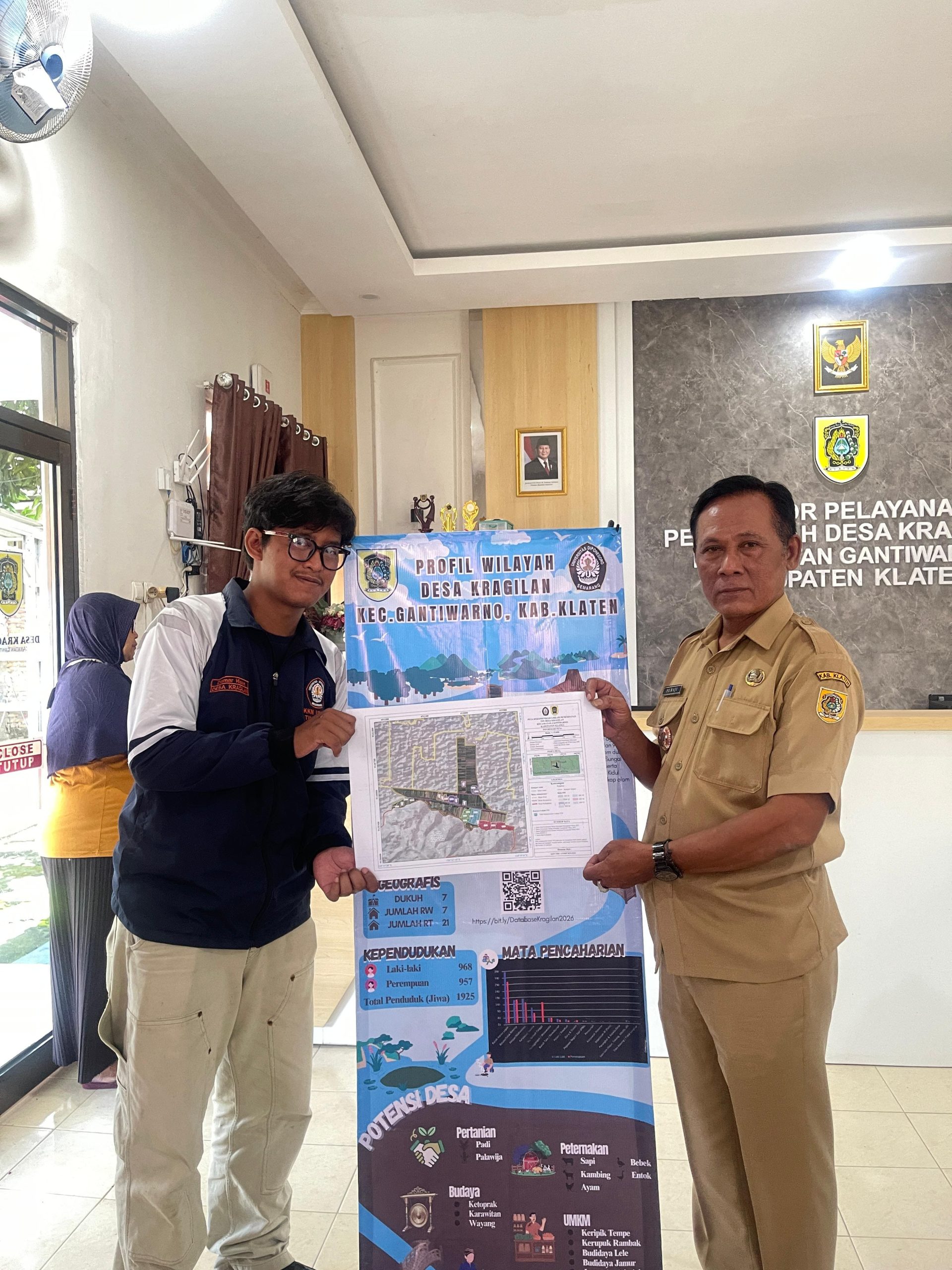
Based on the survey results, Kragilan Village is home to 1,925 residents, consisting of 968 men and 957 women. The population was further classified by age group, including toddlers, children, adults, and elderly residents. In terms of occupation, the majority of residents work as daily laborers, alongside students, entrepreneurs, farmers, traders, and service workers—illustrating the village’s diverse socio-economic structure.
In addition to demographic data, the KKN team also mapped local village potentials, particularly in the fields of culture and Micro, Small, and Medium Enterprises (MSMEs). Several promising MSMEs were identified, such as oyster mushroom cultivation, rambak crackers, tempeh chips, peyek, salted egg production, fish farming (catfish and betta fish), brick making, and traditional herbal drink businesses. These economic activities are spread across several hamlets, including Soka, Kragilan, Teluk, and Balong Kulon.
Kragilan Village also stands out for its strong cultural identity. The village has been officially recognized as a Culture-Aware Village by the Klaten Regency Government. This recognition is supported by the active presence of traditional performing arts groups, such as Sanggar Srikandi Laras and Sanggar Among Roso (karawitan ensembles), as well as Sanggar Cakra Budaya (kethoprak).
The team further documented village infrastructure, including educational facilities, health services, community halls, water supply systems, public lighting, and places of worship. Mapping of street lighting revealed both government-installed and community-initiated lights, providing useful input for future infrastructure improvements. The team also proposed recommended locations for temporary waste disposal sites as part of sustainable environmental planning.
All collected data has been officially submitted to the Kragilan Village Government and displayed at the village office. The data update was formally handed over to the Head of Kragilan Village on February 2, 2026. It is expected that this data will serve as a reliable reference for village administration and future development programs.
Through this activity, UNDIP KKN Team 1 Sub-Team 94 hopes to contribute meaningfully to data-driven, inclusive, and sustainable village development, while strengthening collaboration between universities and local communities.